When you turn on your tap and the water looks milky, white, or intensely cloudy, your first instinct might be to worry about chemical contamination or dirt. However, if that cloudiness completely clears up from the bottom of the glass to the top within a minute or two, the culprit is simply millions of microscopic air bubbles suspended in the water.
This phenomenon is completely harmless and is driven by two primary factors: pressure and temperature.
1. The Physics of Solubilty and Pressure
To understand how air gets trapped in your water, it helps to look at Henry’s Law of physics. This law states that the amount of gas dissolved in a liquid is directly proportional to the pressure surrounding that liquid.
Municipal water systems keep water under high pressure—usually between 40 and 80 pounds per square inch (PSI)—to push it through miles of underground mains and up into multi-story buildings. Because the water is under such intense pressure, it can hold significantly more dissolved air than water sitting in an open container.
When you open your faucet, the water transitions instantly from a high-pressure pipe into an open room at normal atmospheric pressure. Because the pressure has plummeted, the water can no longer hold all that dissolved gas. The air immediately escapes from the solution, forming millions of microscopic bubbles that turn the water milky white.
2. The Role of Temperature
Temperature also plays a major role in how much gas water can hold. Cold water holds dissolved gases much better than warm water.
This is why cloudy water caused by air bubbles is incredibly common during the winter. When freezing cold water travels from an outdoor reservoir into the water mains, it absorbs a large amount of air. As that water enters your home’s plumbing network, it begins to warm up to room temperature. Because warmer water cannot hold as much gas, the air is primed to escape. The moment it hits your faucet and the pressure drops, the air bursts out all at once.
How to Test It: The Glass Test
You can easily verify if your cloudy water is just air by performing a simple visual test:
- Fill a clear glass with the cloudy tap water.
- Set it on a counter and watch it closely for 60 seconds.
- Observe how it clears.
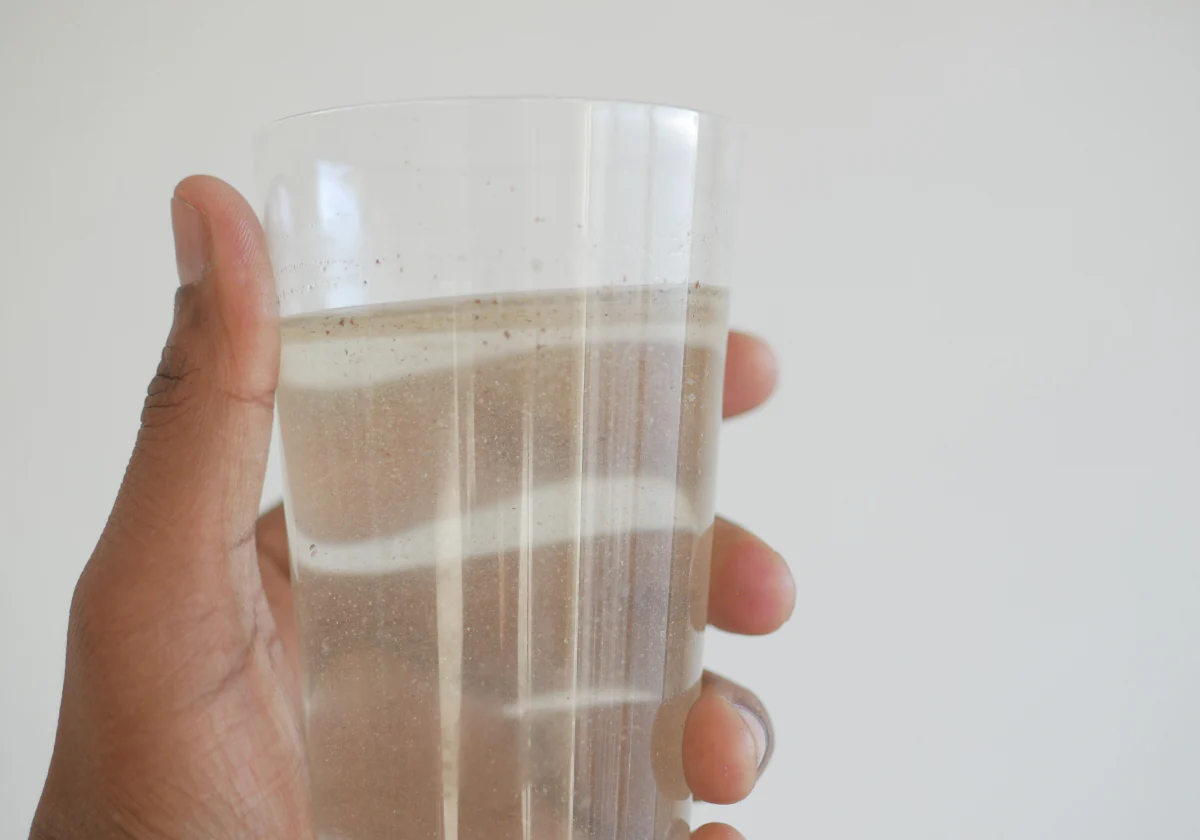
If the water starts clearing from the bottom of the glass to the top, it is definitely air bubbles. Because air is lighter than water, the bubbles slowly float upward and pop at the surface, leaving crystal-clear water behind.
If the water clears from the top down, or if sediment settles at the bottom of the glass, then you are dealing with actual physical particles (like silt or rust) rather than air, which would warrant flushing your lines or contacting your water utility provider.